
Table of Contents
- What Makes This Corridor Attractive for Investment Right Now
- Areas Getting Real Estate Attention Along the Corridor
- Uttarakhand Land Purchase Rules for Non-Residents
- Who Should Consider This Kind of Investment
- Risk Factors Every Buyer Should Weigh
- A Real-World Example: Elixir Prana
- Conclusion
- Frequently Asked Questions
Investment plots near the Delhi Dehradun Expressway are drawing rising attention. The expressway became fully operational on April 14, 2026. It now connects Delhi to Dehradun in around two and a half hours. That is down from roughly six hours before. This shift has changed how investors and second-home buyers view the entire corridor.
This article looks at what makes the corridor attractive, where growth is concentrated, who this kind of investment suits, and the risks worth weighing. This includes a legal restriction many buyers overlook. For a broader overview of the corridor, see the Delhi Dehradun Expressway property investment guide.
What Makes This Corridor Attractive for Investment Right Now
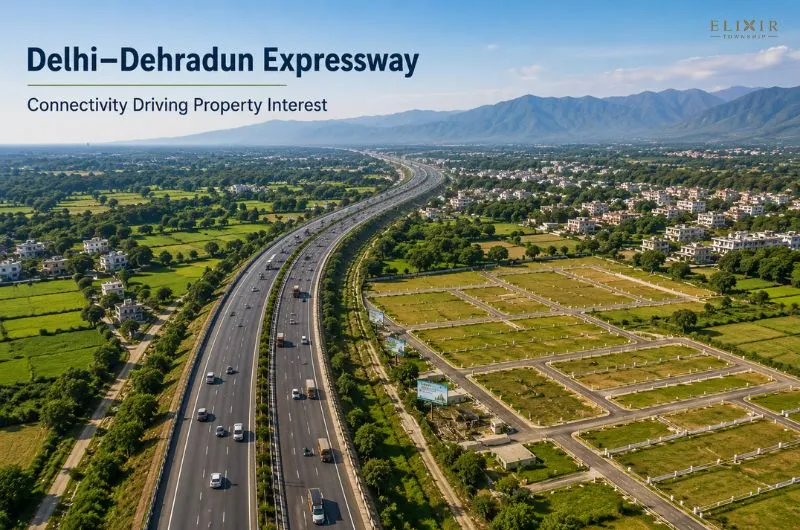
The Delhi Dehradun Expressway is attractive mainly because of reduced travel time and improved regional connectivity. Faster access tends to open new areas to buyers who once found them too far from Delhi NCR.
Several factors are driving interest along the corridor.
- Reduced travel time and clear route landmarks. The corridor runs from Akshardham in Delhi through the Saharanpur Bypass, then through the Ganeshpur stretch and the Dat Kali Tunnel section, before reaching Dehradun, with multiple entry and exit points along the way.
- Air connectivity for out-of-NCR buyers. Dehradun’s Jolly Grant Airport, roughly 25 km from the city centre, gives buyers from outside the Delhi NCR region an additional travel option beyond the expressway.
- Second-home and weekend-home demand. Faster access makes weekend trips to the hills more practical for Delhi NCR residents.
- Industrial and warehousing growth. The expressway connects industrial hubs including Ghaziabad, Noida, Greater Noida, and Meerut to Muzaffarnagar, Saharanpur, and Dehradun. This is expected to support new warehousing demand.
- Tourism-linked growth. Faster connectivity to Haridwar, Rishikesh, and Dehradun is expected to support hospitality and second-home markets in these areas.
Real estate experts have projected price appreciation of around 15 percent to 25 percent in several corridor micro-markets over the next 18 to 24 months, as reported by Moneycontrol and other business publications citing real estate market experts. This is not a government projection, and it should be treated as an expert estimate, not a guaranteed outcome.
Areas Getting Real Estate Attention Along the Corridor
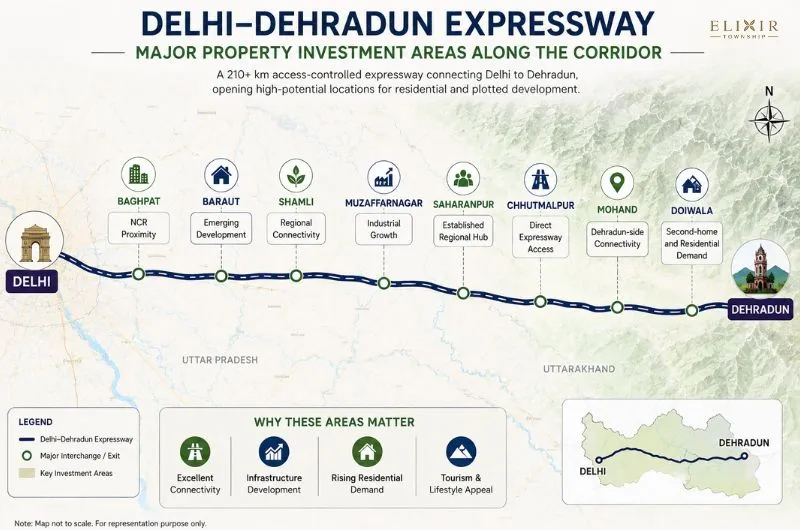
Growth along this corridor is not evenly spread. Certain towns and micro-markets are receiving more attention than others, based on their position along the route and existing infrastructure.
| Area | What Is Driving Interest |
| Baghpat | NCR proximity and early-stage residential and industrial development |
| Baraut | Regional connectivity and rising land demand |
| Shamli | Expressway access and local development activity |
| Muzaffarnagar (outskirts) | Industrial growth alongside residential potential |
| Saharanpur | Regional connectivity |
| Chhutmalpur | Expressway access and early land interest |
| Mohand | Dehradun-side connectivity |
| Doiwala | Residential, tourism, and second-home demand |
Which Areas Are Best for Property Investment Near the Delhi–Dehradun Expressway?
Areas closer to Delhi NCR, such as Baghpat and Shamli, are seeing interest tied to industrial and warehousing growth. Areas closer to Dehradun are seeing more residential and second-home interest. This includes Doiwala, Mohand, and the Ganeshpur area on the Dehradun side of the corridor. For a closer look at one such micro-market, see Plots Near Ganeshpur Toll Plaza.
Some reports also cite early land price increases in specific pockets, such as Baghpat. The scale of these increases varies by source. Buyers should verify any such figures independently before making a decision based on them.
Uttarakhand Land Purchase Rules for Non-Residents
This is one of the most important checks for buyers from outside Uttarakhand. It can directly affect buyers considering plots near Ganeshpur, Doiwala, and Mohand.
Under Uttarakhand’s amended land laws, non-residents face specific restrictions on land purchases. The relevant legislation is the Uttarakhand (Uttar Pradesh Zamindari Abolition and Land Reforms Act, 1950) Amendment Act, 2025.
- Residential land limit. A non-resident can generally purchase up to 250 square meters, or about 300 square yards, of residential land in non-municipal areas.
- Agricultural land restriction. Non-residents cannot generally purchase agricultural or horticultural land in 11 of Uttarakhand’s 13 districts. Haridwar and Udham Singh Nagar follow different rules.
- One-time purchase rule. A buyer generally cannot split a purchase across multiple plots to bypass the size limit, and an affidavit confirming this is typically required.
- Municipal area exception. These size restrictions generally target non-municipal areas. Rules can differ for property within a municipal corporation or a defined urban development area, so this should be confirmed for the specific plot location.
This matters directly for plot sizes on this corridor. Many advertised plots, including some over 400 or 1,000 square yards, exceed the general 250 square meter non-resident limit. Buyers considering larger plots should ask the developer directly how the purchase is structured to comply with this law, whether through municipal-area classification, a different land-use category, or another approved route. This article does not provide legal advice. Buyers should consult a property lawyer familiar with Uttarakhand land law before signing any agreement.
Who Should Consider This Kind of Investment
Not every buyer profile fits this corridor equally well. The right fit depends on investment horizon and budget. It also depends on whether the goal is appreciation, lifestyle use, or both.
| Buyer Type | Why the Corridor Fits | What Matters Most |
| Long-term investor (3 to 5+ years) | Several corridor markets are still developing, with room for infrastructure to mature | RERA registration, developer track record, clear title |
| Second-home or weekend-home buyer | Reduced travel time makes weekend use practical | Location, connectivity, non-resident land limits |
| Industrial or warehousing investor | Corridor links major NCR industrial hubs to Uttarakhand | Zoning, access roads, logistics infrastructure |
| Short-term investor looking for quick resale | Generally a weaker fit given limited resale history | Should weigh liquidity risk carefully |
This is general guidance, not personalized financial advice. Individual circumstances vary. Buyers should assess their own goals before deciding.
Risk Factors Every Buyer Should Weigh
No investment on this corridor is free of risk, despite the strong connectivity story. Buyers should weigh the following factors honestly before committing.
- Liquidity risk. Plots in newer micro-markets can take longer to resell than established residential areas.
- Appreciation is not guaranteed. Expert projections are estimates, not certainties. Actual outcomes vary by location and project.
- Infrastructure timelines. Roads, water, and power connections in newer developments may take time to fully mature.
- Developer risk. Buying from an unregistered or unverified developer increases legal exposure.
- Location risk within the corridor. A plot can sit close to the expressway on a map but still have poor local access. Local roads, drainage, electricity, and water connections matter as much as expressway proximity.
- Boundary and encroachment risk. Vacant plots can be vulnerable to encroachment if left unmonitored. Ask about boundary marking, fencing, and any ongoing maintenance or security charges.
- Financing availability. Not every plotted project qualifies for standard home-loan financing. Confirm directly with your bank or the developer before assuming a loan is available.
- Holding period mismatch. This corridor generally suits medium to long-term holding, not quick flips.
Quick Due-Diligence Checklist
Before buying any plot on this corridor, confirm the following.
- The project has a valid RERA registration, checked directly on the state RERA portal.
- The land is freehold, with clear and verifiable title documents.
- The layout has a sanctioned plan from the relevant development authority.
- An encumbrance certificate confirms the land carries no unresolved claims.
- The approach road to the plot is legally accessible and not privately owned by an unrelated party.
- The land-use classification and any required development permissions are verified and in place.
- For Uttarakhand-side plots, non-resident purchase limits and compliance route are confirmed in writing.
- The plot’s exact location is verified against official revenue records and the approved layout, rather than relying only on the distance shown in advertisements.
For a full walkthrough of the RERA verification step, see RERA Approved Plots Near Dehradun: How to Verify Before You Buy.
A Real-World Example: Elixir Prana
Among the projects marketed along this corridor is Elixir Prana, a plotted development near Ganeshpur Toll Plaza. It is an example of the type of gated plotted township being promoted in this stretch of the corridor, close to Rajaji National Park.
This article does not recommend any specific project. Before considering any plot here or elsewhere on the corridor, buyers should independently confirm the current RERA number and status, exact pricing, possession or development stage, loan financing availability, and how any purchase over the non-resident land limit is structured, directly with the project and a qualified lawyer.
Project Website: Elixir Prana
Conclusion
The Delhi Dehradun Expressway has created a stronger connectivity story for property markets along its length. This runs from Baghpat and Shamli near Delhi to Doiwala and Ganeshpur near Dehradun. Connectivity alone does not guarantee investment returns. Actual outcomes depend on location, legal title, non-resident land rules, and independent verification of every claim.
Frequently Asked Questions
It can be a reasonable option for buyers with a medium to long-term horizon, given the corridor’s improved connectivity. Actual outcomes depend on the specific location, project, legal status, and applicable land purchase rules.
Real estate experts project appreciation of around 15 to 25 percent in several micro-markets over the next 18 to 24 months. These are expert estimates, not guarantees, and figures vary by location.
This depends on the buyer’s goals. Plots suit buyers who want land ownership and design flexibility, subject to applicable land rules. Apartments may suit buyers who want a ready-to-use property with fewer ownership restrictions.
This depends on the buyer’s goal. Baghpat and Shamli suit buyers focused on NCR proximity and industrial growth. Doiwala, Mohand, and Ganeshpur suit buyers focused on residential or second-home use near Dehradun.
Confirm RERA registration, title and ownership documents, sanctioned layout, approach road access, and land-use classification. On the Uttarakhand side, also confirm non-resident land purchase limits.
A medium to long-term holding period may suit this corridor better than a quick resale strategy. Infrastructure and demand are still developing in several micro-markets.
