Table of Contents
- 1. RERA Registration and Legal Clarity
- 2. Proximity to Expressway Access Points
- 3. Developer Track Record
- 4. Demand Drivers and Surrounding Development
- 5. Infrastructure and Development Maturity
- 6. Plot Size and Investment Budget
- 7. Exit Potential and Liquidity
- Quick Checklist: Evaluating the Best Plots Near Dehradun for Investment
- Red Flags to Watch Before Buying
- A Practical Example: Elixir Prana
- Conclusion
- Frequently Asked Questions
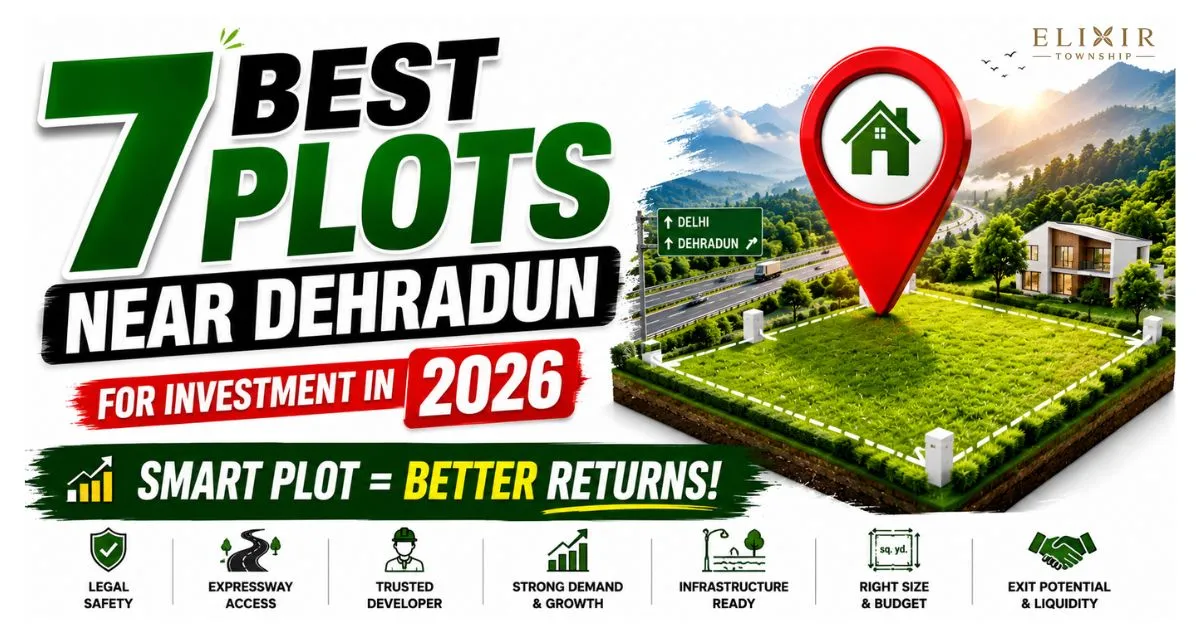
Finding the best plots near Dehradun for investment is not about picking a name off a list. It is about checking a plot against a consistent set of criteria. This guide breaks down 7 factors that separate a strong investment plot from a risky one. Use them to compare projects more objectively before making a decision.
For a broader overview of this corridor, including its route, growth drivers, and legal considerations, see the Delhi-Dehradun Expressway property investment guide. This guide focuses on how to judge whether a specific plot is worth considering, not just why the region is growing.
1. RERA Registration and Legal Clarity
The single most important starting point is RERA registration. A registered project has disclosed its layout, project details, and timelines to the state regulator.
RERA registration is only one part of due diligence, not proof of clear title. Buyers should separately verify title documents, freehold status where applicable, land-use status, encumbrances, the approved layout, mutation records, and applicable permissions. Before shortlisting any plot, confirm its RERA number directly on the official state RERA portal, and do not rely on a developer’s claim alone.
2. Proximity to Expressway Access Points
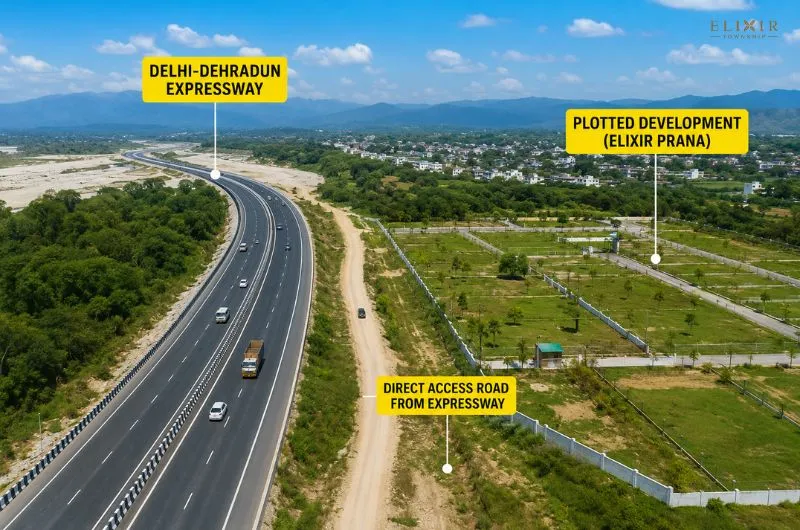
Distance from the Delhi Dehradun Expressway matters, but exact access matters more. A plot can look close to the expressway on a map but still have weak practical access. Check the approach road, its width, and how well it connects to the main carriageway.
Ganeshpur, near the Shimla Bypass, is one example of an access point worth evaluating on the Dehradun side of the corridor.
3. Developer Track Record
A strong investment plot usually comes from a developer with a visible track record. This includes completed projects, not just active launches.
Ask for details of any earlier projects, and if possible, speak to existing buyers or residents. Check whether previous projects were delivered on time. Also check whether the final layout matched what was originally approved, and whether the developer still maintains those projects after handover. A developer with no prior delivery history carries more risk, regardless of how the current project is marketed.
It also helps to check how long the developer has operated in the local market. A longer local track record can give buyers more evidence to evaluate than a new entrant.
Buyer tip: ask to walk through a completed project in person rather than relying only on photos. A short site visit often reveals maintenance quality and finishing standards that a brochure will never show.
4. Demand Drivers and Surrounding Development
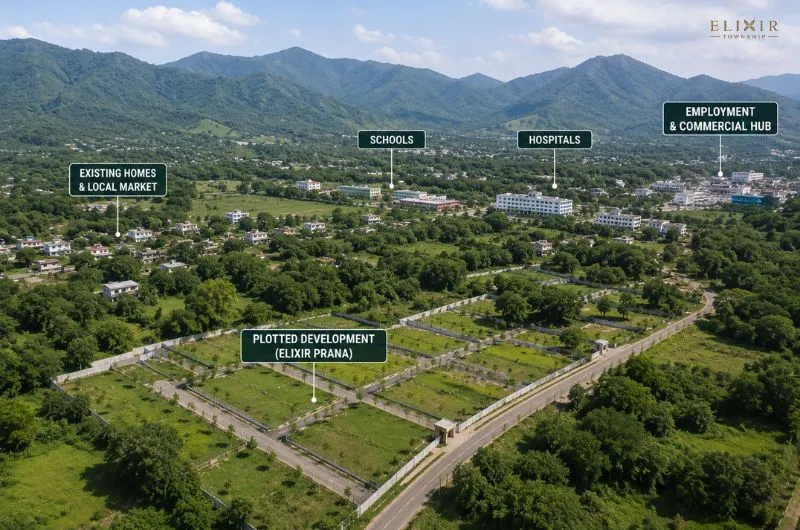
Appreciation potential usually follows specific demand drivers, such as improved connectivity, second-home demand, nearby industrial growth, and tourism activity.
The Delhi Dehradun Expressway has significantly improved connectivity between the two cities. This kind of connectivity shift is one of the clearest demand drivers on this corridor, since it directly expands the pool of buyers who find a location practical. A location with genuine demand drivers is generally stronger than one relying only on projected appreciation. For a deeper look at these growth drivers and the risks tied to them, see Investment Plots on the Delhi Dehradun Expressway.
What to Check Around the Project
Beyond the headline connectivity story, look at what already exists nearby:
- Existing homes and residential activity in the immediate area
- Nearby markets, schools, and hospitals
- Employment hubs or industrial areas within reach
- Tourism or hospitality activity, where relevant
A location with genuine surrounding activity can support stronger demand and resale potential than one that exists only on a master plan.
5. Infrastructure and Development Maturity
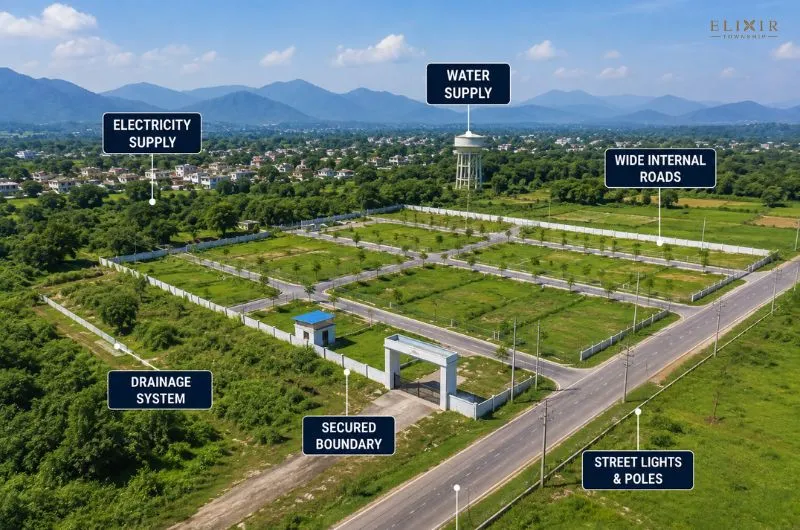
Roads, water, and power matter more for investment value than a clubhouse or landscaping. Amenities alone do not make a plot a good investment, but their absence often signals an early or incomplete development stage.
Look for underground wiring, proper road widths, drainage, a reliable water supply, reliable electricity infrastructure, street lighting, and a functioning security setup, not just a rendered master plan. Ask who is responsible for ongoing maintenance once the project is handed over.
A dedicated clubhouse, landscaped parks, or a green belt buffer can support long-term demand on top of this, particularly for second-home and weekend-home buyers.
Buyer tip: if you can, visit the site during or right after rain. Drainage issues that stay hidden on a dry day usually show up within minutes of a downpour.
6. Plot Size and Investment Budget
Plot size should match your entry budget, intended use, holding period, and exit strategy. There is no single best size. It depends on your goal.
| Plot Size | Typical Investment Fit |
| Under 300 sq. yd. | Lower-entry investment |
| 300 to 600 sq. yd. | Mid-budget investment |
| 600 sq. yd. and above | Premium or long-term investment |
Smaller plots may appeal to a wider budget range, while larger plots suit buyers with longer holding periods. Buyers from outside Uttarakhand should also verify the current non-resident land purchase rules before booking a larger plot, since these rules can change.
7. Exit Potential and Liquidity
A good investment plot should have a realistic exit path. Where possible, compare recent resale transactions for similar plots instead of relying only on quoted asking prices.
A properly documented gated plotted development can offer easier due diligence than unclear or unregistered land, since buyers can verify its title, layout, and approvals more directly. Liquidity in newer micro-markets can still take longer than in established areas, so weigh this honestly against your own holding period. Buyers should also account for registration costs, development charges, maintenance, taxes, and other transaction expenses, since the quoted plot price is not the full cost of the investment.
Quick Checklist: Evaluating the Best Plots Near Dehradun for Investment
Buyer tip: carry this checklist with you on an actual site visit, not just as a mental note. Buyers who ask questions off a written list tend to get clearer answers and negotiate with more confidence.
Before shortlisting a plot as a genuine investment option, confirm the following.
- RERA number verified directly on the state portal
- Title, land-use status, and mutation records confirmed through documents
- Developer has a visible track record of completed, well-maintained projects
- Approach road and last-mile access inspected, not just map distance
- Surrounding development, such as homes, markets, and schools, checked
- Plot size fits your budget, holding period, and resale goals
- Basic infrastructure, including roads, water, and drainage, is already in place
- Comparable resale prices checked, where available
- Non-resident land rules confirmed, if applicable
- Total purchase and ownership costs estimated, including registration, development, and maintenance charges
Red Flags to Watch Before Buying
A few warning signs are worth treating seriously, regardless of how a project is marketed.
- Unclear or undisclosed title
- RERA details that cannot be independently verified
- An unapproved or informally shared layout
- Unclear land-use status
- A poor or disputed approach road
- Appreciation promises that sound unrealistic
- Little to no surrounding development
- No evidence of past resale activity
- Pressure to book quickly without time to verify documents
A Practical Example: Elixir Prana
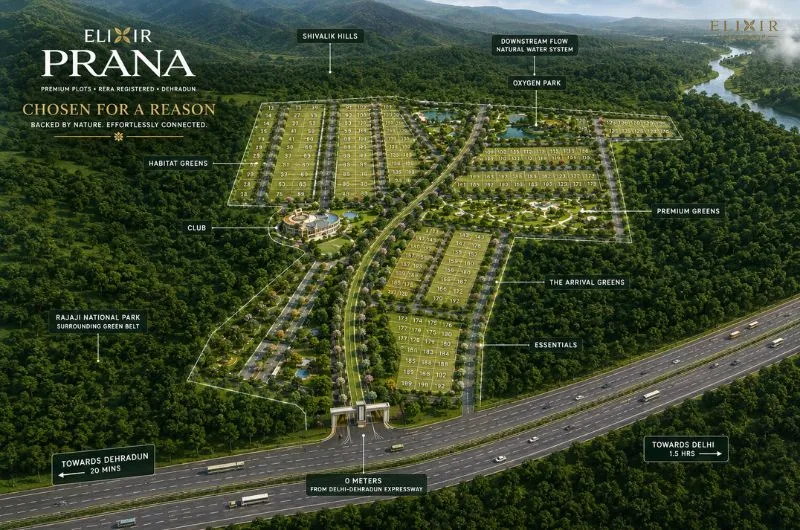
Among the projects that fit several of these criteria is Elixir Prana. It is a plotted development near Ganeshpur Toll Plaza on the Delhi Dehradun Expressway. It offers plots ranging from 272 to 1050 square yards, close to Rajaji National Park, with gated infrastructure including a clubhouse and a dedicated Oxygen Park.
This is one example of the type of project buyers may evaluate on this corridor, not a recommendation. Buyers should independently confirm RERA status, ownership type, and current pricing directly with the project.
Learn more about Elixir Prana, including its location, plot sizes, and project features, on the Elixir Prana homepage.
Conclusion
The best plots near Dehradun for investment are not defined by brand names or marketing claims. They are defined by RERA status, real access, developer history, surrounding development, and a realistic exit path. The right plot should also match your budget, holding period, and exit plan. Apply these factors consistently, and you can evaluate any plot on this corridor on its actual merits, not its advertising.
Frequently Asked Questions
Look at legal clarity, location and access, demand drivers, infrastructure, developer history, and resale potential together, rather than relying on any single factor.
This depends on your goal. Smaller plots may suit buyers with lower budgets, while larger plots may suit long-term or end-use buyers.
Ask for details of previously completed projects, not just current launches, and check whether those projects are still well maintained. Speak with existing buyers or residents where possible.
A properly documented gated development may offer easier due diligence and resale than unclear or unregistered land. Buyers should still verify title, land-use status, and approvals independently, since RERA registration alone does not guarantee clear title.
Amenities alone do not guarantee returns, but their presence often signals a more mature development stage. Basic infrastructure such as roads, water, and drainage is a stronger indicator than premium features like a clubhouse.
